Friday, October 24, 2008

The Tall and Short of It

I'm crazy for cuphea. I mean really, I could be "the crazy cuphea lady". Why? Cause cuphea are committment-free plants. You just stick them in the ground and they go year in and year out. I have no idea what glories they would achieve with a little more water and some occassional food but these plants are the doormats of the plant world - they take abuse with a smile. If they were people instead of plants they would surely be in therapy learning to stand up for their needs. But alas, they are among the voiceless masses so they just do what is asked of them without a word of protest.

In my hot, sunny yard there are several cuphea that bloom heavily all summer and are also hummingbird and butterfly attractors. In the Charleston area they die to the ground every winter but are always in bloom again by the time the hot weather kicks in and continue blooming well into fall as you can tell by these pictures taking on October 23. These two cupheas are both commonly called Cigar Cuphea but are different varieties - one large and one small. The orange flowers of both are toned down by their maroon stems and dark green leaves which I think rescues them from the brink of gaudiness.


Cuphea ignea, one of several plants commonly called firecracker plant, is the shorty of the two. Mine has never gotten over about 18 inches tall but then again it has had to survive on rain water for survival and is planted in almost pure sand. I'm not always a good plant mom!


Cuphea micropetala, or giant cigar plant, is much bigger. Its other common name, candy corn cuphea, is more descriptive and alluringly alliterative too! This one gets to four to five feet tall.

All the cuphea I've grown do best in full sun and look great even in poor soil and low water.


Thursday, October 23, 2008

You Dirty Boy, You!


Who would have ever known that prissy angel trumpets could hide such a dirty secret? I guess dirt is what you get when you go peeping up a boy's skirt. (C'mon, surely you knew Angel's Trumpets were cross-dressers, didn't you? They are way too big to be real women.) Yes, the ballet dancers of the flower world have evidently been rolling around in the lowly muck.

In my zone 8ish/9ish yard, this brugmansia has flushed once, about a month ago, and has started a very lopsided (preference towards the sun) second flush. They die back completely to the ground every winter and take till fall to start blooming again. In downtown, penninsular Charleston (which is all of maybe 4 miles away as the crow flies) they can be evergreen thanks to the urban heat island and two rivers warming the land in between.

Oh the scent! In the heat of day, I can't smell it at all. But as I walk past my frontyard on my evening walks, the scent is undeniable- not overwhelming or cloying but defintely sweet and beautiful.

Brugs love lots of cow poop, lots of water, some afternoon shade, and the fawning attention of passersby.

Wednesday, October 22, 2008

Tidy Torch Tithonia


Ah, relief at last from the towering tithonias! This tithonia rotundifolia "torch" has stayed under 4 feet which is midget by tithonia standards and is a much bushier and, well, basically just nicer looking plant all the way around. Tithonia (or Mexican Sunflower) is a self-seeding annual in the Charleston area. This one planted itself outside my fence and has never seen the first drop of supplemental water but that hasn't slowed it down one bit. In the softer sunlight of autumn, the orange is just gorgeous.

Tuesday, October 21, 2008

Okra's Kith and Kin

As any good gumbo eating southerner knows: okra loves the south! While sane humans are hiding in their air conditioned houses, okra is soaking up the sun. An early proponent of solar power, it uses it to propel itself to incredible heights and lengthen pods visibly overnight. So it makes perfect sense that okra's kith and kin are happy plants in the southern garden. The okra cousins featured below have been super easy plants in my garden, all thriving in full sun, heat, humidity, and drought. All are easy to grow from seed and in fact self-seed rather freely.


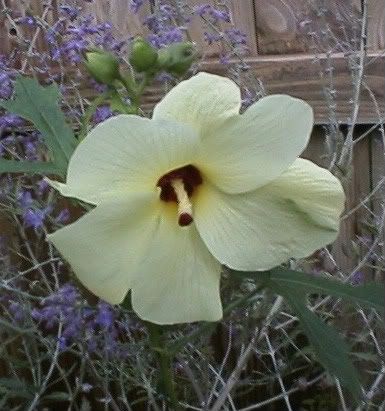
If okra (abelmoschus esculentus) has a fraternal twin, Abelmoschus manihot, or Sunset Hibiscus, may just be it. Their soft yellow flowers are virtually identical and they reach the same soaring heights but the leaves and seedpods vary a bit.


Every family has a runt and in the Okra family Abelmoschus moschatus may be it. Although I've read that they can reach a few feet tall, in my area they seem to top out at less than a foot. It turns out that the common name, musk mallow, applies because the oil from the seeds is commonly used in the perfume industry as a plant form of musk thereby sparing the endangered musk deer and is one of the key ingredients in one of Chanel's new fragrances. See http://indieperfumes.blogspot.com/2007/02/ambrette-seed.html if you feel compelled to make your own smelly stuff.


My neighbor and I discovered this beauty on a plant collection expedition on a southeast barrier island. The barrier island does happen to be heavily populated AND it is five miles from our front door AND we did find the plant in a heavily cultivated and probably commercially landscaped front yard BUT other than that Tony Avent has nothing on us- we are plant explorers.

Unable to collect seeds, we searched for the plant online, thought we id'ed it, and ordered seeds. Neighbor friend planted them at the base of her picket fence and waited for them to fill their allotted to 2'x3' space. At two feet, they were still growing. At five feet, they were still growing. Within a couple of months they could have been used as Christmas trees in someone's soaring entry hall as their hulking pyramid shapes topped out well over 8' tall with an equal spread at the base. Methinks our plant id'ing skills failed us!

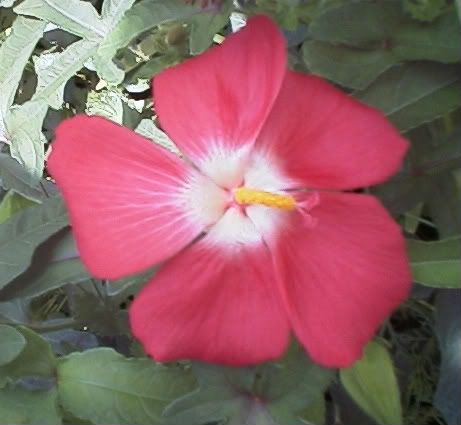
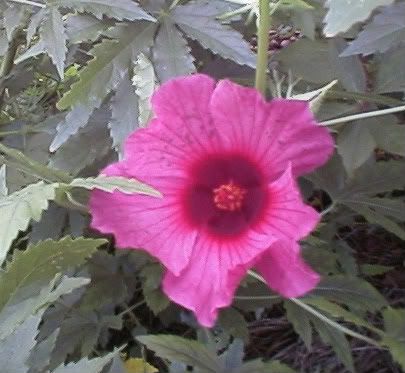
We still don't know what we first saw but we do know that what she grew was hibiscus radiatus and when I inherit a 20-acre garden from some benevolent stranger I may plant it again. In the meantime, it is preserved in pictures and in memories of its beautifully colored flowers and viciously prickly seedpods.


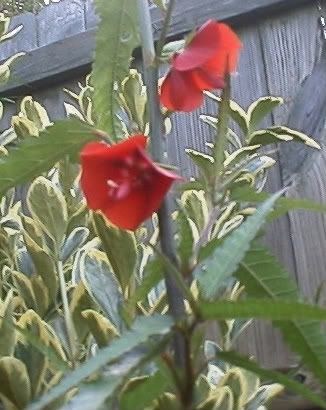
Pentapedes Phoenicia or Scarlet Mallow is a ridiculously spindly, awkward fellow when planted alone but in groups makes quite a show. With minimal branching, the smallish red cup-shaped blooms open along the trunk. They reach about 4' tall and one inch wide. Okay, maybe a bit more than an inch wide but these guys are so skinny they do have to turn sideways in a rainshower to get wet. Give them about 12-16" to make the full turn.

Monday, October 20, 2008

Ferns on a Rock


The other day was too beautiful to stay inside so Anne and I went out a-walking. We headed toward Columbia, SC to Peachtree Rock Heritage Preserve. Fellow coastal-plainers will understand the joy of hills and rocks to flatlanders like us as it is a sight not seen here by the ocean. It`s a great walk with ancient rolling sand hills, short rock ledges and a strange mixture of plants. There is even a waterfall-the only one on SC's coastal plain.

The vegetation is a mix of what is typical in coastal sand hills with a bit of mountain flora along the shaded creek. The ferns were sitting on the sandstone outcrops and were lush from the previous days rain. The surprise of the walk was the native Cheilanthes or lip ferns which were "hiding in plain sight" surrounded by resurrection ferns.

These xeric fern are gray-green and fuzzy and grow on bare rock. Some were next to the resurrection ferns while others sat alone on the bare surface. I don`t know which species they are but they do not look like any other fern in the area. In the top picture above, the unusual coloring and texture of the fern are visible.

In my garden I grow a couple of species (Cheilanthes tomentosa and C. eckloniana) with my succulents. The bed (seen in the second picture above) is in full sun all day, fast draining because it is raised yet the ferns look soft and fresh as any well cared for woodland species. That gray and fuzzy look has been admired by Anne since I planted them. It was a thrill for both of us to see a specimen in the wild.

If you have a fast draining spot in the garden give one of these a try. It`s like a vegetable teddy bear: fuzzy and appealing. Online vendors like Plant Delights now carry them.


Sunday, October 12, 2008

Chinese Fan Palms


Anne fell in love this year. She would call with comments and questions and I knew it was for real: she had discovered Livistona chinensis. It is a great palm Walmart always has cheaply in the house plant section. Bright shiny green leaves on a slow growing plant (in south Florida it grows like a weed) that will tolerate full sun or part shade.


Twenty-two degrees seems to be the temp where the leaves burn off but the plant quickly comes back from fifteen. An evergreen canopy can help keep the leaves a little longer in cold weather. In my 8b neighborhood it is damaged every other year, in Anne's zone 9 garden rear the water it may go for years without damage. So give it a try!

Little Palms


I`m a lover of palms and it is one of the reasons I live in Charleston,SC. In my mind, palms are tall trees bending in the wind not small shrubby plants acting as ground cover. I now know that one of the most beautiful cold tolerant palms is a little gem, Chamaedorea radicalis.


She is a beauty: small and dainty, dark green leaves and brilliant red fruits that is easy to grow. She can also be a he, since the sexes are on separate plants in this species. Normally just a clump of 6 or 8 feathery leaves rising from the ground, you`ll be surprised every once in a while by a plant that produces a trunk.


Shade is what they need and even watering sincetheir homeland is the cloud forest of north east Mexico. When they are happy and you have both sexes you`ll have their distinctive "v" seedlings come up all over the yard. Under a canopy Radicalis palms look best in mass, forming a mid-level just above the ground cover. Fifteen degrees has never bothered mine as long as they are under a canopy. They give your garden that tropical look but tolerate the vagaries of the southeast because they evolved in this climate in Mexico. Let`s start giving them a new home!