Showing posts with label tropicals. Show all posts

Sunday, January 2, 2011

Yellow Bells


Now that the weather has grown cold it is time for some summer memories of warmth and bright flowers. One of my favorite tropical plants is yellow bells (Tecoma stans)! This is one of the easiest plants to grow and gives so much for so little work.


Yellow bells have a cluster of one to two inch lemon yellow trumpets at the top of the stem. My plants always freeze to the ground but by Memorial Day are 2' tall and beginning to bloom. The blooming season last till the first killing frost and I then cut them down.


I must let you know they grow fast and get 6' to 7' tall! The common type from the wet tropics grow a number of tall stems that are wands capped with flowers. A more refined look is the desert variety Tecoma stans angustifolia. This type has smaller flower clusters but the plant is bushier and each stem branches more often for a fuller look. The leaves are much finer cut and shinier making the plant more garden worthy than the tropical type. Best of all it is less likely to set seed and thus is not loaded with 6" bean pods by the hundreds.


The picture is of the desert yellow bell!

Monday, November 8, 2010

A Fall Vignette


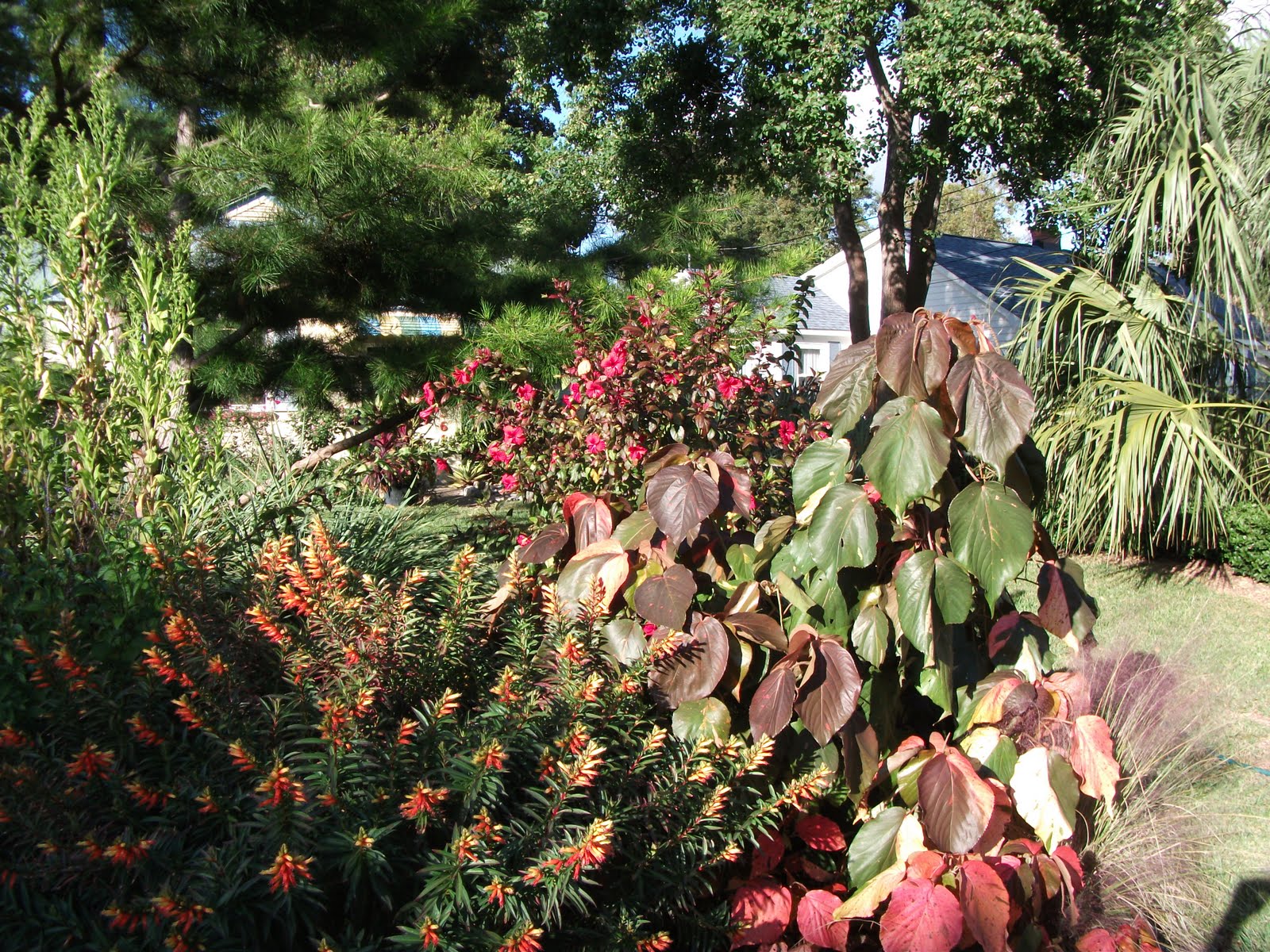
Just a quick flash of fall for us Southerners, since the trees won`t provide the color we let the herbaceous and tropicals do it. This grouping of Mexican cigar flowers, Acalypha Jungle Dragon and a variegated hibiscus in a pot provide the warm rich colors that give us that fall feeling . That is if we are transplanted Northerners.
The potted hibiscus was just brought in the house for the winter and cut back. I also took cuttings of the acalypha because it doesn`t always return from the roots. The cigar flower is just a good doer and will be back with the spring. So far there has not been a frost or freeze, but this far inland it will happen soon and I want to be prepared.

Monday, July 12, 2010

Textures

As a plant nut I usually worry about if the plant will grow here ,not what it will look like and because of that I`ve spent a lot of time moving things around. There are happy accidents where everything turns out right and not because I tried.


The pond is a small 20+ gallons that a friend found in a trash pile. I placed it near another small pond at the edge of my woodland garden so it would get some sun part of the day. It`s an ugly plastic thing that I used resurrection fern to hide the edge. The only plant in the pond is a veriegated Acorus.


The bright colored Acorus shines against the dark water and at the same time contrasts with low clustering ferns. Along side the pond the golden Sedum picks up the color of the Acorus and the texture of the ferns. On the backside of the pond the fern Phlebodium aureum 'Blue Crisp' adds a new color while continueing the fern texture on a bigger scale.


Oh the happy mistakes!


The other plants in the photo are some radiclis palms, Aspidistra and Agapathus. The Blue Crisp has proven to be not only winter hardy but with an overhead canopy is evergreen.

Thursday, December 18, 2008

Okay, So I'm a Bit Obsessed


But it isn't my fault really. Charleston is just such a great laboratory for observing microclimates. Like this tropical hibiscus blooming today in downtown Charleston long after the hibiscus in my yard just across the harbor were killed by the frost. This particular plant bloomed all last winter and never had any frost damage at all and is now reaching for the second floor of the building.
This plant, though, was born with a horticultural silver spoon in its, ah, mouth:
  • It is planted up against a heat-retaining brick wall.
  • It is located just a few hundred feet from the Charleston Harbor where the heat retained by the water warms the air a bit. The entire penninsula of Charleston is warmer than surrounding areas because the two rivers that flank it provide a slight warming to the air.
  • It is located in downtown Charleston which is warmer due to the effects of the urban heat island.
I'm very jealous. The hibiscus in my yard won't bloom until next fall because they will have to come back all the way from the root IF they come back at all. What a difference a few miles can make.

Saturday, December 6, 2008

The Tropics Are Just a Live Oak Away

The tropics are just a live oak away? Okay, maybe not. There are no coconut palm lined beaches magically appearing on the other side of my live oak tree. There is no secret door in the trunk that magically opens to a warmer, sunnier place. But.....there are tropical plants that thrive under the live oak.

Charleston straddles USDA Plant Hardiness Zone Ho-Hum (or 8b), with minimum temperatures of 15-20 degrees, and USDA Plant Hardiness Zone Ooh-La-La (or 9a), with minimum temperatures of 20-25 degrees. What grows in Zone Ooh-La-La? Think tropical hibiscus, some bromeliads, an expanded range of palms, tropical ferns. I want that! So I keep shoving more marginal plants under the protective canopy of my live oak.


The happy little collection of strobilanthes, aechmea, vriesea gigantea "Nova", and monstera in this November 30 photo was unscathed by the scattering of freezing temps that had knocked back other tender plants in exposed areas of my yard. Will they all make it through the winter? Who knows. I have serious doubt about the monstera and even the sturdier plants in that group may die if we have an exceptionally cold weather. In the meantime though, I love having that bit of color hanging on in my yard.

A live oak can help gain those few precious degrees that mean a tropical that would normally die is instead root-hardy (hopefully the case with the monstera) or that a tropical that normally would only be root-hardy is evergreen (for example, the Persian Shield). On a cold night, the closed canopy of the live oak acts like a cozy down blanket by trapping the warmer air radiated up from the ground. That same "blanket" also prevents plant cell damaging frost from settling on leaves and stems.

How much of a difference does it make? Seeing is believing. In a downtown Charleston park, this Persian Shield, lying just a few feet outside the dripline of a Live Oak, was top-killed by freezing temps a few days ago:
But just ten feet away, under the protective cover of the same Live Oak, this Persian Shield is untouched by the cold:

And because it hasn't been killed back in years, it has these great big leaves:

Same story with this groundcover which is also outside the dripline of the Live Oak:

And again just ten feet away, is the same plant, same day:

I have no idea what this little groundcover is. Any suggestions? I do know that under that tree it is perennial.
Of course, it isn't only live oaks that afford some freeze protection. This Blue Daze is sheltered by the lorapetalum in the background but just a few feet away ten more Blue Daze are all top-dead:


If these plants all thrive this winter, my azaleas and holly ferns had better watch out... Zone Ooh-La-La will be moving on in!

Thursday, October 2, 2008

Acalypha (copperleaf)


What is huge and sassy and multicolored all over? In my early-fall garden, it is acalypha (wilkesiana, maybe). Planted as tiny little 4-inch potted plants this June, my two acalyphas are now great big showy burst of color that just sit there and do their thing without any intervention on my part. God bless their colorful little souls. My good friend Mike, who knows all things botanical, declared in mid-summer when I was lamenting their still diminutive size, that acalyphas seem to take a few weeks to settle in but then just take off and he was (as always) right. After about 4 weeks of sitting there doing nothing, they suddenly doubled and then redoubled in size and then just kept growing. Yeah, the frost will kill them and I will have to start over with fresh plants next spring (a fact that my south Florida brother has a hard time with) but I'll be more than willing to shell out a few dollars for this tropical and just pretend it is an annual.

Bonus points for being heat, humidity, and drought-tolerant!