Showing posts with label drought. Show all posts

Friday, November 7, 2008

Garden Jewels

We always want what we cannot have and mine is a succulent garden. By my front door I have built a small raised bed out of gravel and rocks and planted it with assorted desert plants. The site is in full sun all day and open to the breeze, just the spot where you think every succulent would do well. Well, some of them do.

The first casualty was the much talked about Aloe polyphylla, it went into a slow decline its second year and was eventually moved. It was from this I learned that succulents can hang a long time but fungicides and a good environment can`t always save a plant.

From left to right; Graptopetalum paraguayense, Sedum palmeri and an unknown Sedaveria


There have been successes, a sedaveria of unknown name has grown so well it has wandered out of the raised bed and has become a ground cover for a native viburnum. It has stopped spreading(it drops leaves which then root) when it hit the point where a puddle forms from roof run off. Another is Aloe humilis, a little clustering plant that grows as well in the raisd bed as it does in the regular soil.


The background plant is the Othona, the foreground is Sedum bithyncum and a Manfreda sp.


Another happy plant is Othona cherifolia from north Africa. A winter bloommer with small yellow daisies flowering over a long period, the plant is so fast that after each bloom eriod I cut it back and throw the clippings around the yard and see what survives. About half the time the clippings rot and grow.

Monday, November 3, 2008

Sweetgrass


These two birds are a perfect match for my wildlife photography skill level- posing patiently in their bronze glory while I take thirty different images right up in their faces. I'm not sure who they are supposed to be, great blue herons, maybe? The pair, in their sweetgrass nest, mark the entrance way to a new development next to my neighborhood. The developers put in all the infrastructure, including retention ponds and landscaping, before being stalled by the housing slump. What can I say? There loss is our gain as we now have a combination stroll park and dog park and are all loving it.

Isn't the sweetgrass surrounding the birds almost unbelievably frothy? Sweetgrass (muhlenbergia capillaris or muhly grass) is a workhorse most of the year, surviving with little water, providing a bit of vertical accent but not much wow factor. In the fall, however, when the sun is lower in the sky and shines through its delicate blooms the workhorse becomes a showhorse.

Our town has mass planted sweetgrass in the median of the main drag, maybe in part a tribute to 'the basket ladies' who have for decades made sweetgrass baskets at roadside stands on the same road, practicing a craft handed down from enslaved ancestors who worked the rice plantations along the coast. There is a bit more history and some pictures of baskets here:
http://www.cofc.edu/sustainability/sweetgrass%20brochure.pdf


I found this little sweetgrass basket (hold on a minute while I get the glass cleaner for that mirror) in a neighbor's trash! Any locals, or tourists, who have ever priced the baskets know what a true find that was. A day in the trashpile left it a little lopsided but otherwise none the worse.

Just this fall I put 15 clumps of sweetgrass in a ridiculously sandy, dry, and sunny strip outside my fence where nothing else will grow. Hopefully in years to come it will thrive and put an end to my multi-year quest of what to do with that space. So far, so good.

Wednesday, October 22, 2008

Tidy Torch Tithonia


Ah, relief at last from the towering tithonias! This tithonia rotundifolia "torch" has stayed under 4 feet which is midget by tithonia standards and is a much bushier and, well, basically just nicer looking plant all the way around. Tithonia (or Mexican Sunflower) is a self-seeding annual in the Charleston area. This one planted itself outside my fence and has never seen the first drop of supplemental water but that hasn't slowed it down one bit. In the softer sunlight of autumn, the orange is just gorgeous.

Tuesday, October 21, 2008

Okra's Kith and Kin

As any good gumbo eating southerner knows: okra loves the south! While sane humans are hiding in their air conditioned houses, okra is soaking up the sun. An early proponent of solar power, it uses it to propel itself to incredible heights and lengthen pods visibly overnight. So it makes perfect sense that okra's kith and kin are happy plants in the southern garden. The okra cousins featured below have been super easy plants in my garden, all thriving in full sun, heat, humidity, and drought. All are easy to grow from seed and in fact self-seed rather freely.


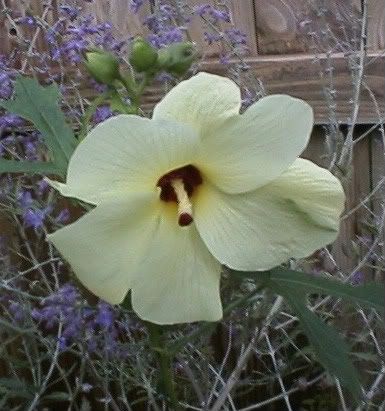
If okra (abelmoschus esculentus) has a fraternal twin, Abelmoschus manihot, or Sunset Hibiscus, may just be it. Their soft yellow flowers are virtually identical and they reach the same soaring heights but the leaves and seedpods vary a bit.


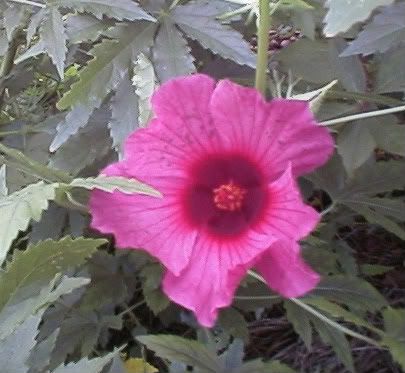
Every family has a runt and in the Okra family Abelmoschus moschatus may be it. Although I've read that they can reach a few feet tall, in my area they seem to top out at less than a foot. It turns out that the common name, musk mallow, applies because the oil from the seeds is commonly used in the perfume industry as a plant form of musk thereby sparing the endangered musk deer and is one of the key ingredients in one of Chanel's new fragrances. See http://indieperfumes.blogspot.com/2007/02/ambrette-seed.html if you feel compelled to make your own smelly stuff.


My neighbor and I discovered this beauty on a plant collection expedition on a southeast barrier island. The barrier island does happen to be heavily populated AND it is five miles from our front door AND we did find the plant in a heavily cultivated and probably commercially landscaped front yard BUT other than that Tony Avent has nothing on us- we are plant explorers.

Unable to collect seeds, we searched for the plant online, thought we id'ed it, and ordered seeds. Neighbor friend planted them at the base of her picket fence and waited for them to fill their allotted to 2'x3' space. At two feet, they were still growing. At five feet, they were still growing. Within a couple of months they could have been used as Christmas trees in someone's soaring entry hall as their hulking pyramid shapes topped out well over 8' tall with an equal spread at the base. Methinks our plant id'ing skills failed us!

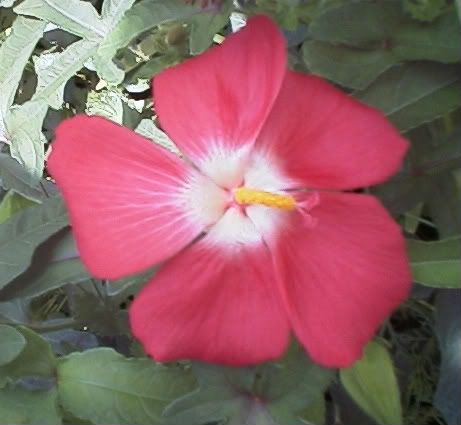
We still don't know what we first saw but we do know that what she grew was hibiscus radiatus and when I inherit a 20-acre garden from some benevolent stranger I may plant it again. In the meantime, it is preserved in pictures and in memories of its beautifully colored flowers and viciously prickly seedpods.


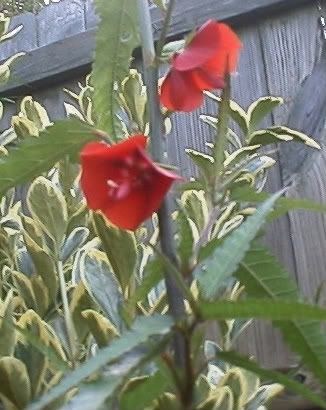
Pentapedes Phoenicia or Scarlet Mallow is a ridiculously spindly, awkward fellow when planted alone but in groups makes quite a show. With minimal branching, the smallish red cup-shaped blooms open along the trunk. They reach about 4' tall and one inch wide. Okay, maybe a bit more than an inch wide but these guys are so skinny they do have to turn sideways in a rainshower to get wet. Give them about 12-16" to make the full turn.

Monday, October 20, 2008

Ferns on a Rock


The other day was too beautiful to stay inside so Anne and I went out a-walking. We headed toward Columbia, SC to Peachtree Rock Heritage Preserve. Fellow coastal-plainers will understand the joy of hills and rocks to flatlanders like us as it is a sight not seen here by the ocean. It`s a great walk with ancient rolling sand hills, short rock ledges and a strange mixture of plants. There is even a waterfall-the only one on SC's coastal plain.

The vegetation is a mix of what is typical in coastal sand hills with a bit of mountain flora along the shaded creek. The ferns were sitting on the sandstone outcrops and were lush from the previous days rain. The surprise of the walk was the native Cheilanthes or lip ferns which were "hiding in plain sight" surrounded by resurrection ferns.

These xeric fern are gray-green and fuzzy and grow on bare rock. Some were next to the resurrection ferns while others sat alone on the bare surface. I don`t know which species they are but they do not look like any other fern in the area. In the top picture above, the unusual coloring and texture of the fern are visible.

In my garden I grow a couple of species (Cheilanthes tomentosa and C. eckloniana) with my succulents. The bed (seen in the second picture above) is in full sun all day, fast draining because it is raised yet the ferns look soft and fresh as any well cared for woodland species. That gray and fuzzy look has been admired by Anne since I planted them. It was a thrill for both of us to see a specimen in the wild.

If you have a fast draining spot in the garden give one of these a try. It`s like a vegetable teddy bear: fuzzy and appealing. Online vendors like Plant Delights now carry them.


Thursday, October 9, 2008

Hibiscus Panama Red


"Is that a Japanese Maple?" is the question I hear regularly when people first spy the Hibiscus Panama Red, the gorgeous painted monster that squats in the front corner of my yard. And with its deeply cut and deeply red foliage it is easy to see the resemblance. This was a "give it a try buy" from a big-box store in early summer that has more than earned its keep. Like a lot of the other plants I rave about, it fits my criteria of heat, humidity, and drought tolerant. Evidently, Allan Armitage at the University of Georgia agrees as it has been selected as one of their favs in the Athens Select program (see http://ugatrial.hort.uga.edu/index.cfm/fuseaction/home.showpage/pageID/13/index.htm).

Hibiscus acetosella (Panama Red or False Roselle) is not winter-hardy in my area although I've read that it might overwinter if it had some overhead protection from settling frost. Next year I'll give that a try by planting it under the perimeter of my cluster of Live Oaks. Panama Red has not flowered for me but who needs flowers with foliage this spectacular? In early October, my plant is nearly 5 feet tall and more than 6 feet at the widest. Imagine the size if I hadn't had to cut it back severely after it was wind damaged by a tropical storm six weeks ago! With lower branches touching the ground, there is absolutely nothing leggy or gangly about this plant

Saturday, October 4, 2008

A "Shoutout" for White Profusion Zinnias


These plants amaze me! They are huge (2-3 feet across, albeit a bit splayed in the middle), constantly covered in the promised profusion of blooms, and the blooms themselves are always covered in an unpromised profusion of butterflies of a half dozen varieties. The white profusion zinnias not only tolerate heat, humidity, and drought but seem to take suffocating, stifling temps as a personal challenge and reach their most glorious dimensions after several weeks of roasting in the sun. AND they are self-deadheading. The bleach-stained coloring of the orange and pink versions annoy me but the white - wow!

Just the facts: they will take all the sun you can give them, don't need a lot of water, and reach 15-24 inches tall and 2-3 feet wide. Plant early for biggest results. Gulf fritillary butterflies love them.

Thursday, October 2, 2008

Acalypha (copperleaf)


What is huge and sassy and multicolored all over? In my early-fall garden, it is acalypha (wilkesiana, maybe). Planted as tiny little 4-inch potted plants this June, my two acalyphas are now great big showy burst of color that just sit there and do their thing without any intervention on my part. God bless their colorful little souls. My good friend Mike, who knows all things botanical, declared in mid-summer when I was lamenting their still diminutive size, that acalyphas seem to take a few weeks to settle in but then just take off and he was (as always) right. After about 4 weeks of sitting there doing nothing, they suddenly doubled and then redoubled in size and then just kept growing. Yeah, the frost will kill them and I will have to start over with fresh plants next spring (a fact that my south Florida brother has a hard time with) but I'll be more than willing to shell out a few dollars for this tropical and just pretend it is an annual.

Bonus points for being heat, humidity, and drought-tolerant!