Showing posts with label humidity. Show all posts

Sunday, January 2, 2011

Yellow Bells


Now that the weather has grown cold it is time for some summer memories of warmth and bright flowers. One of my favorite tropical plants is yellow bells (Tecoma stans)! This is one of the easiest plants to grow and gives so much for so little work.


Yellow bells have a cluster of one to two inch lemon yellow trumpets at the top of the stem. My plants always freeze to the ground but by Memorial Day are 2' tall and beginning to bloom. The blooming season last till the first killing frost and I then cut them down.


I must let you know they grow fast and get 6' to 7' tall! The common type from the wet tropics grow a number of tall stems that are wands capped with flowers. A more refined look is the desert variety Tecoma stans angustifolia. This type has smaller flower clusters but the plant is bushier and each stem branches more often for a fuller look. The leaves are much finer cut and shinier making the plant more garden worthy than the tropical type. Best of all it is less likely to set seed and thus is not loaded with 6" bean pods by the hundreds.


The picture is of the desert yellow bell!

Friday, October 24, 2008

The Tall and Short of It

I'm crazy for cuphea. I mean really, I could be "the crazy cuphea lady". Why? Cause cuphea are committment-free plants. You just stick them in the ground and they go year in and year out. I have no idea what glories they would achieve with a little more water and some occassional food but these plants are the doormats of the plant world - they take abuse with a smile. If they were people instead of plants they would surely be in therapy learning to stand up for their needs. But alas, they are among the voiceless masses so they just do what is asked of them without a word of protest.

In my hot, sunny yard there are several cuphea that bloom heavily all summer and are also hummingbird and butterfly attractors. In the Charleston area they die to the ground every winter but are always in bloom again by the time the hot weather kicks in and continue blooming well into fall as you can tell by these pictures taking on October 23. These two cupheas are both commonly called Cigar Cuphea but are different varieties - one large and one small. The orange flowers of both are toned down by their maroon stems and dark green leaves which I think rescues them from the brink of gaudiness.


Cuphea ignea, one of several plants commonly called firecracker plant, is the shorty of the two. Mine has never gotten over about 18 inches tall but then again it has had to survive on rain water for survival and is planted in almost pure sand. I'm not always a good plant mom!


Cuphea micropetala, or giant cigar plant, is much bigger. Its other common name, candy corn cuphea, is more descriptive and alluringly alliterative too! This one gets to four to five feet tall.

All the cuphea I've grown do best in full sun and look great even in poor soil and low water.


Tuesday, October 21, 2008

Okra's Kith and Kin

As any good gumbo eating southerner knows: okra loves the south! While sane humans are hiding in their air conditioned houses, okra is soaking up the sun. An early proponent of solar power, it uses it to propel itself to incredible heights and lengthen pods visibly overnight. So it makes perfect sense that okra's kith and kin are happy plants in the southern garden. The okra cousins featured below have been super easy plants in my garden, all thriving in full sun, heat, humidity, and drought. All are easy to grow from seed and in fact self-seed rather freely.


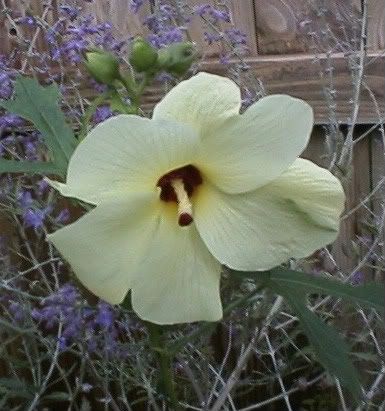
If okra (abelmoschus esculentus) has a fraternal twin, Abelmoschus manihot, or Sunset Hibiscus, may just be it. Their soft yellow flowers are virtually identical and they reach the same soaring heights but the leaves and seedpods vary a bit.


Every family has a runt and in the Okra family Abelmoschus moschatus may be it. Although I've read that they can reach a few feet tall, in my area they seem to top out at less than a foot. It turns out that the common name, musk mallow, applies because the oil from the seeds is commonly used in the perfume industry as a plant form of musk thereby sparing the endangered musk deer and is one of the key ingredients in one of Chanel's new fragrances. See http://indieperfumes.blogspot.com/2007/02/ambrette-seed.html if you feel compelled to make your own smelly stuff.


My neighbor and I discovered this beauty on a plant collection expedition on a southeast barrier island. The barrier island does happen to be heavily populated AND it is five miles from our front door AND we did find the plant in a heavily cultivated and probably commercially landscaped front yard BUT other than that Tony Avent has nothing on us- we are plant explorers.

Unable to collect seeds, we searched for the plant online, thought we id'ed it, and ordered seeds. Neighbor friend planted them at the base of her picket fence and waited for them to fill their allotted to 2'x3' space. At two feet, they were still growing. At five feet, they were still growing. Within a couple of months they could have been used as Christmas trees in someone's soaring entry hall as their hulking pyramid shapes topped out well over 8' tall with an equal spread at the base. Methinks our plant id'ing skills failed us!

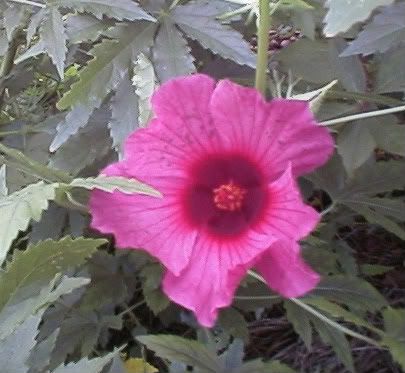
We still don't know what we first saw but we do know that what she grew was hibiscus radiatus and when I inherit a 20-acre garden from some benevolent stranger I may plant it again. In the meantime, it is preserved in pictures and in memories of its beautifully colored flowers and viciously prickly seedpods.


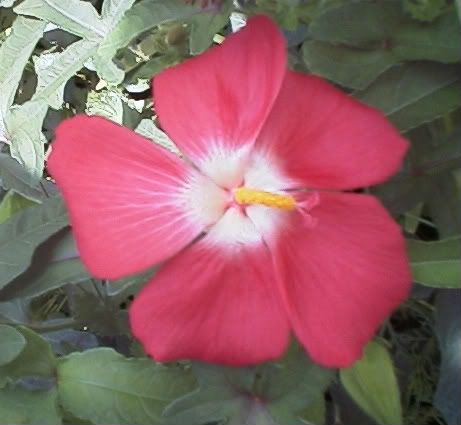
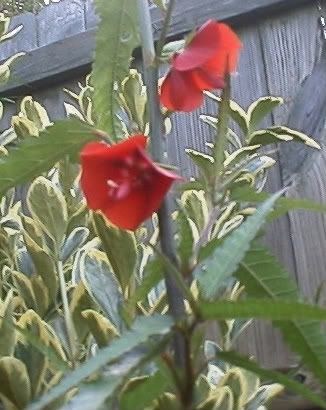
Pentapedes Phoenicia or Scarlet Mallow is a ridiculously spindly, awkward fellow when planted alone but in groups makes quite a show. With minimal branching, the smallish red cup-shaped blooms open along the trunk. They reach about 4' tall and one inch wide. Okay, maybe a bit more than an inch wide but these guys are so skinny they do have to turn sideways in a rainshower to get wet. Give them about 12-16" to make the full turn.

Thursday, October 9, 2008

Hibiscus Panama Red


"Is that a Japanese Maple?" is the question I hear regularly when people first spy the Hibiscus Panama Red, the gorgeous painted monster that squats in the front corner of my yard. And with its deeply cut and deeply red foliage it is easy to see the resemblance. This was a "give it a try buy" from a big-box store in early summer that has more than earned its keep. Like a lot of the other plants I rave about, it fits my criteria of heat, humidity, and drought tolerant. Evidently, Allan Armitage at the University of Georgia agrees as it has been selected as one of their favs in the Athens Select program (see http://ugatrial.hort.uga.edu/index.cfm/fuseaction/home.showpage/pageID/13/index.htm).

Hibiscus acetosella (Panama Red or False Roselle) is not winter-hardy in my area although I've read that it might overwinter if it had some overhead protection from settling frost. Next year I'll give that a try by planting it under the perimeter of my cluster of Live Oaks. Panama Red has not flowered for me but who needs flowers with foliage this spectacular? In early October, my plant is nearly 5 feet tall and more than 6 feet at the widest. Imagine the size if I hadn't had to cut it back severely after it was wind damaged by a tropical storm six weeks ago! With lower branches touching the ground, there is absolutely nothing leggy or gangly about this plant

Saturday, October 4, 2008

A "Shoutout" for White Profusion Zinnias


These plants amaze me! They are huge (2-3 feet across, albeit a bit splayed in the middle), constantly covered in the promised profusion of blooms, and the blooms themselves are always covered in an unpromised profusion of butterflies of a half dozen varieties. The white profusion zinnias not only tolerate heat, humidity, and drought but seem to take suffocating, stifling temps as a personal challenge and reach their most glorious dimensions after several weeks of roasting in the sun. AND they are self-deadheading. The bleach-stained coloring of the orange and pink versions annoy me but the white - wow!

Just the facts: they will take all the sun you can give them, don't need a lot of water, and reach 15-24 inches tall and 2-3 feet wide. Plant early for biggest results. Gulf fritillary butterflies love them.

Thursday, October 2, 2008

Acalypha (copperleaf)


What is huge and sassy and multicolored all over? In my early-fall garden, it is acalypha (wilkesiana, maybe). Planted as tiny little 4-inch potted plants this June, my two acalyphas are now great big showy burst of color that just sit there and do their thing without any intervention on my part. God bless their colorful little souls. My good friend Mike, who knows all things botanical, declared in mid-summer when I was lamenting their still diminutive size, that acalyphas seem to take a few weeks to settle in but then just take off and he was (as always) right. After about 4 weeks of sitting there doing nothing, they suddenly doubled and then redoubled in size and then just kept growing. Yeah, the frost will kill them and I will have to start over with fresh plants next spring (a fact that my south Florida brother has a hard time with) but I'll be more than willing to shell out a few dollars for this tropical and just pretend it is an annual.

Bonus points for being heat, humidity, and drought-tolerant!